 Deutsch
 English





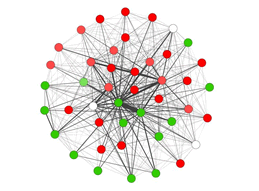

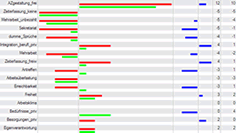
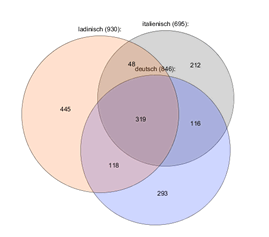


In order to understand an organization, people’s relationships with each other, their knowledge, basic beliefs and goals must be perceived and understood. This is the purpose of the GABEK® procedure (complete management of complexity). It allows a representation of conceptual and knowledge networks of an organization and their interpretation.
Category Publications
Learning and Development in Organizations
Learning and Development in Organizations
Favorable organizational development requires learning processes of organization members. To stimulate learning processes, one can start from the experience that the affected persons have had. Experience consists in the networking of perceptual, evaluation and knowledge elements, which has proven itself in many different situations. For this reason, the present volume shows how networks of perceptual, evaluation and knowledge elements can be analyzed and represented by the GABEK method.
Study on German teaching presented at Italian schools
GABEK® curriculum evaluation

After more than ten years of the curriculum, the Pedagogical Institute for the Italian Language Group has initiated a reflection on the value and status of this curriculum with its own project. The project was developed by the pedagogical staff of the Institute Klaus Civegna and Univ.-Prof. Siegfried Baur. Univ.-Prof. Dr. Josef Zelger conducted a GABEK evaluation of the curriculum.
Structures of reasoning in the Wittgenstein estate MS 115
The Wittgenstein Archives at the University of Bergen (WAB)
There is a need for a short and clear presentation of the Wittgenstein estate. So one might ask how the topics that Wittgenstein occupied in his series "Philosophical Remarks" are related in an argumentative way.
Qualitative research by the GABEK® method
in Qualitative Research – Different Perspectives – Emerging Trends, 2004
It is one of the central tasks of the social sciences and humanities to show ways and means of creatively processing complex problems in our society. Such problems are generally unstructured and difficult to define. Frequently they are tied to dynamic situations affecting a large number of individuals or groups of individuals. On the other hand, the experiences gained by those affected, e.g. the employees of an institution, contain creative problem solving potential.
Qualitative Research by the method GABEK
Josef Zelger, Preprint Nr. 78, February 2003
It is one of the central tasks of the social sciences and humanities to show ways and means of creatively processing complex problems in our society. Such problems are generally unstructured and difficult [...]
GABEK II – Qualitative research
On Qualitative Research

In addition to considerations on the practical application of the GABEK method, the contributions of this anthology are concrete implementations of GABEK in the economic and didactic fields. On the basis of an introduction to GABEK, the following topics are dealt with: GABEK as a method in qualitative research and its further development, theory formation, evaluation, application in recruitment and opinion research as well as in management and psychology.
The reliability of shape formation in the GABEK process – A Metatheoretical Analysis
Andries G de Wet, Anne-Marie Pothas, Potchefstroom University, South Africa
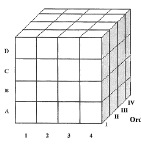
GABEK has been widely used as a methodology for qualitative analysis and has proven to be a valuable tool. As with any methodology, the question arises: How reliable are the results of the GABEK investigations?
The design tree of the GABEK method: theory and method based on examples
Knowledge organization through linguistic formation in the qualitative process GABEK
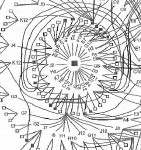
If we try to order disordered linguistic expressions, it may be useful to first examine the process of sense perception. Both perception and thought are human interaction processes with the environment through which [...]
GABEK I – Processing and Presentation of Knowledge

How can one present the rich experience or attitudes and wishes of several hundred employees of a company, institution, party or association?